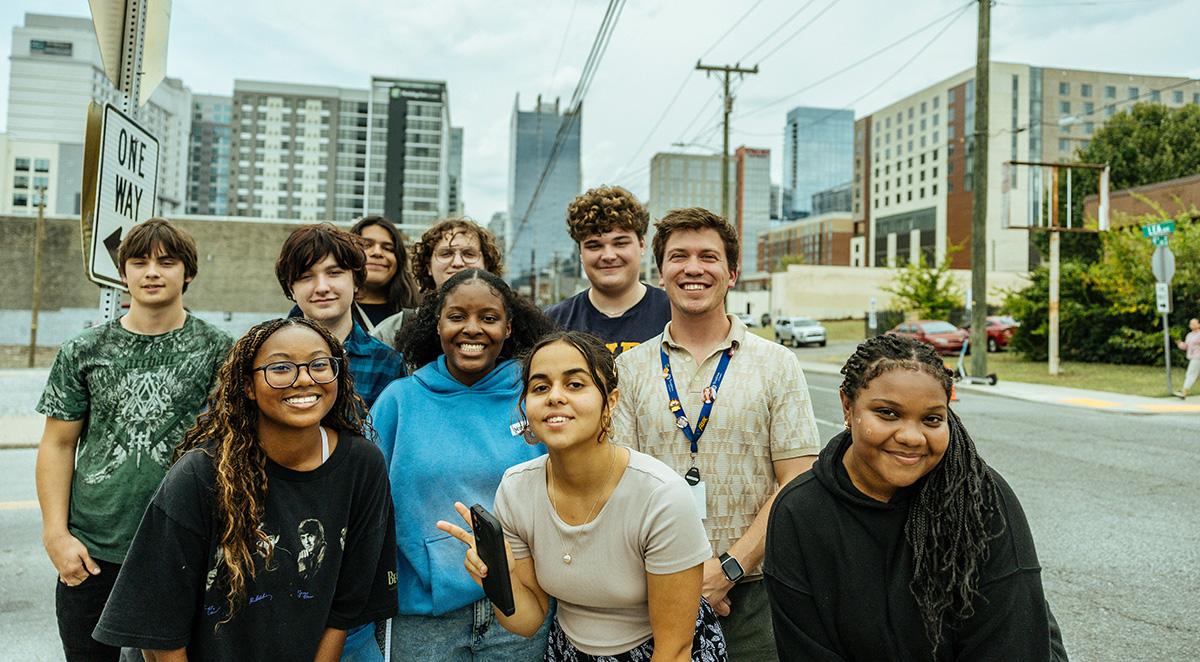
Ask a group of adults what they actually remember from school, and most won't name a worksheet. They'll name a project, a trip, a moment when learning felt real. That's the idea behind experiential learning, and it's at the center of how City School of Nashville teaches students in grades 5 through 12.
This article explains what experiential learning really is, why it works, and how a city like Nashville becomes one of the best classrooms a student can have.
Quick Summary
- Experiential learning means learning by doing, then reflecting on the experience.
- It tends to stick because it connects ideas to real people, places, and problems.
- Fieldwork is more than a field trip; it's a planned, purposeful part of the curriculum.
- Beyond academics, it builds confidence, independence, and real-world skills.
- City School treats Nashville as an extension of the classroom, with fieldwork built into the week.
What Is Experiential Learning?
Learning by Doing
Experiential learning is exactly what it sounds like. Instead of only reading about a subject, students step into it, through projects, experiments, interviews, and hands-on work.
The learning doesn't stop at the activity, though. Students reflect on what happened, connect it back to the concepts they're studying, and carry those lessons into the next challenge.
Why It Sticks
Information tends to fade when it's disconnected from experience. When a student measures a real bridge, interviews a real business owner, or solves a real problem, the concept attaches to a memory.
That's why experiential learning often outlasts test-prep facts. The student didn't just memorize an idea, they lived it.
How It Differs From a Traditional Classroom
In a traditional classroom, knowledge usually flows one way, from teacher to student, and success is measured by how well a student can recall it later. That model has its place, but it leaves a lot of learners on the sidelines.
Experiential learning flips the flow. Students take an active role, testing ideas, making choices, and sometimes getting things wrong on the way to understanding. The teacher becomes a guide rather than the only source of answers.
The two approaches aren't really opposites, and most good schools blend them. The question for families is one of emphasis, because a school built around experience asks students to do more than absorb information. It asks them to use it.
For a child who tunes out during lectures but lights up during projects, that shift in emphasis can change how they feel about school altogether.
Why Fieldwork Matters More Than Ever
The world our children will enter rewards people who can apply what they know. Employers and colleges increasingly look for initiative, collaboration, and the ability to solve messy, open-ended problems.
Those skills are hard to build from a desk. They grow when students step into real situations, work with real people, and figure things out as they go.
Fieldwork also reconnects learning to purpose. A student who sees how math shapes a city budget, or how history lives in a neighborhood, understands why the subject matters in the first place.
None of this replaces strong academics. Instead, it gives academics somewhere to land, turning facts and skills into tools a student actually knows how to pick up and use.
What Fieldwork Teaches Beyond Academics
Confidence in New Situations
Navigating an unfamiliar place, meeting new people, and asking good questions all take practice. Regular fieldwork gives students that practice, and confidence grows every time they handle something new. A student who was once nervous to speak up learns, week by week, that they can hold their own in the wider world.
Real-World Skills
Out in the city, students learn to plan, communicate, and adapt. They read a schedule, introduce themselves to a professional, and adjust when a plan changes, which are skills no textbook teaches as well as experience does. These are also the everyday abilities that colleges and employers notice long before they check a transcript.
A Sense of Community
When students spend time in their city, they start to feel like they belong to it. They see the people and institutions that make a community work, and they begin to imagine their own place in it. That sense of belonging often grows into a genuine desire to contribute.
How City School Uses the Whole City
The City as Classroom
City School treats Nashville as an extension of the classroom. Teachers are encouraged to take their classes out regularly, and over a single year, our students take dozens of excursions across the city.
You can see how this fits into the wider program on our Academics Overview page.
A Wide Range of People and Places
In a given month, students might study civics at the State Capitol, analyze architecture downtown, or talk with a working professional about their craft. The goal is to introduce students to as broad a range of careers and communities as possible.
That range matters. A student who meets a doctor, an artist, and a public official in the same season starts to see how many futures are open to them.
Prepared and Supported
Fieldwork only works when students feel ready for it. We preview new experiences, prepare students ahead of time, and build in the support that lets everyone take part.
For students who need a little more warning before a change of scene, that preparation makes the difference between stress and success. We'd rather set a student up to succeed than throw them into the deep end, so every excursion is planned with the whole group in mind.
Questions to Ask a School About Fieldwork
If experiential learning matters to you, a few questions on a tour will tell you how seriously a school takes it. Ask about frequency, purpose, and support rather than settling for a general promise.
Consider asking:
- How often do students actually leave campus for learning, and in which subjects?
- How is fieldwork tied to what students are studying in class?
- How do you prepare students who find new places or changes stressful?
- What does a typical excursion look like from start to finish?
- How do students reflect on what they learn out in the field?
The answers will tell you whether fieldwork is a core part of the program or an occasional treat. A school that has thought it through will answer easily and with specifics.
Is This Approach Right for Your Child?
Experiential learning is a wonderful fit for curious, proactive students who are ready to step into a hands-on day. These are learners who would rather do than sit and watch.
It asks something of students, too. Because so much learning happens out in the world, students need to be comfortable with movement, new places, and the occasional change of plan. Our blog on signs your child would thrive in project-based learning can help you think that through.
For families whose child needs a highly structured, low-activity setting, a different model may fit better, and that's completely okay. The goal is always to find the right match for your child. The best way to tell is to watch how your child learns when no one is making them, because that instinct usually points you in the right direction.
In Their Own Words
As City School parent Keri A. shared:
"Our daughter LOVES going to school again and is excited to talk about what she's done each day."
Frequently Asked Questions
What's experiential learning?
Experiential learning is learning by doing, followed by reflection. Students engage directly with real projects, people, and places, then connect those experiences back to the concepts they're studying.
Isn't fieldwork just field trips?
Not quite. A field trip is often a one-off outing, while fieldwork is a planned, purposeful part of the curriculum, tied directly to what students are learning and repeated throughout the year.
Is experiential learning a good fit for neurodiverse learners?
It can be a wonderful fit for neurodiverse students who are proactive and ready for a hands-on day, especially with the previewing and preparation we build in. City School is a small, supportive school where students are known and supported, not a special-education or clinical program, so we encourage families to visit and talk with us.
What grades does City School serve?
We serve grades 5 through 12, spanning middle school (grades 5 to 8) and high school (grades 9 to 12).
The Bottom Line
The best learning tends to happen when students step out of their seats and into the world. Experiential learning turns a city into a set of teachers, and it turns a student from a passive listener into an active participant.
If you want to see what a city-as-classroom education looks like in practice, we'd love to show you. It tends to make far more sense once you've watched it up close.
Schedule a tour or contact us to start the conversation.